

Overflow call handling routes excess inbound calls to alternate resources, human or automated, so no caller is left unanswered when your team is stretched. For most small businesses and trades, the most practical starting point is a hybrid setup: keep your core team handling calls during normal hours, then add automated or outsourced overflow for nights, weekends and spikes. It costs less than hiring extra staff and stops jobs slipping away to the next number on the list.
TL;DR:
- Overflow call handling is essential when peak call volumes cause abandonment rates above 5 to 8 percent, which indicates lost customers and missed jobs.
- hybrid models combining AI, callbacks, and outsourced agents offer the most cost-effective and controlled solution for predictable call surges.
- Key setup factors include real-time detection of busy queues, integration with existing systems, clear escalation protocols, and detailed reporting on call metrics.
- Implemented correctly, overflow routing activates instantly when thresholds are met, reducing caller wait times and preventing delays in response.
- Starting automation with routine inquiries, such as appointment checks, maximizes quick returns before scaling to more complex call handling.
Table of Contents
- What is overflow call handling and when do you need it?
- What are the best overflow call handling strategies?
- How do you choose and set up an overflow solution?
- What KPIs actually prove overflow handling is working?
- Technical activation notes for IT and telephony teams
- How does an AI receptionist for trades actually work?
- A pragmatic starter plan for small businesses
- Never miss another job because of a missed call
- Sources
- FAQ
What is overflow call handling and when do you need it?
Overflow call handling is not the same as a generic answering service. An answering service simply takes a message when nobody picks up. Overflow handling is a system: it monitors your call queue and automatically diverts calls to a backup resource, whether that's another agent, an outsourced team, or an AI receptionist, the moment a threshold is crossed. Overflow solutions route excess inbound calls to trained agents or automated handlers precisely so a caller never sits in silence.
The causes are rarely a mystery once you look at them:
- Seasonal peaks — a plumber gets four times the call volume during a cold snap; a landscaper sees the same in spring.
- Promotions or marketing pushes — a discount campaign drives calls faster than your phone line can absorb.
- Outages or emergencies — a burst pipe across a whole estate floods your line in minutes.
- After-hours demand — most trades still get called at 7pm, when nobody is at the desk.
- Staff shortages — someone calls in sick and suddenly your one-person reception becomes a bottleneck.
The trigger to act is measurable, not a gut feeling. Watch your abandonment rate (the share of callers who hang up before being answered) and your average speed to answer. A practical rule of thumb: abandonment rates above roughly 5 to 8% during peak windows mean you're losing customers who won't call back.
What are the best overflow call handling strategies?
Once you know overflow is a problem, the question becomes which mechanism handles it. Here are the five approaches worth shortlisting, roughly in order of complexity:
- Smart routing and IVR — an interactive voice response menu deflects and prioritises calls, sending billing questions one way and emergencies another before a human ever gets involved.
- Callbacks and virtual queuing — instead of holding, callers get offered a scheduled callback. This cuts perceived wait time to zero even though the actual wait hasn't changed.
- Outsourced live overflow agents — a third-party team picks up calls your staff can't reach, giving high-touch, human coverage during genuine surges.
- AI voice agents and virtual receptionists — software that answers, asks the right questions, and captures job details (name, address, problem, urgency) without a human on the line at all.
- Hybrid models — a blend of the above, matched to call type and time of day.
Hybrid models that route routine inquiries to AI agents while escalating complex calls to humans tend to be the most cost-efficient option for predictable peaks, because you're not paying for idle headcount to cover an hour of chaos on a Monday morning.
Each option trades cost against control. IVR is cheap but frustrates callers who just want a human. Outsourced agents give you real conversations but need ongoing brand training to stay consistent. AI receptionists sit in between: cheaper than a full outsourced desk, faster to deploy than hiring, and increasingly capable of handling trade-specific queries without sounding robotic.
Pro Tip: Start automation with your most repetitive call types, not your most complex ones. Industry guidance suggests that 40 to 60% of inbound calls are routine, tier-one queries, things like appointment confirmations or status checks, so automating those first delivers the fastest return.
How do you choose and set up an overflow solution?
Vendors will all claim they're fast and flexible. Test that claim against a short checklist before you sign anything.
- Activation speed — how quickly does the system detect a busy queue and reroute? Real-time detection matters more than a polished dashboard.
- Integration — does it plug into your existing CRM or phone system, or does it require ripping out what you already have?
- SLAs and escalation paths — what happens when the overflow provider itself is overwhelmed? There should be a documented next step, not a shrug.
- Reporting — can you see call volumes, response times, and outcomes without chasing someone for a spreadsheet?
Ask any provider or your own IT contact these questions directly: What's the average time from missed call to callback? Who owns quality control on scripts? Can thresholds be adjusted without a support ticket?
On the configuration side, the basics are consistent across most business phone systems. You'll typically set an overflow number as the backup destination, define business-hours schedules so overflow only kicks in outside your working window (or during a defined peak), and set queue thresholds, for example, route to overflow after three unanswered rings or 30 seconds on hold.

Onboarding is where quality either holds or falls apart. Write scripts that match how your team actually talks. Keep brand tone consistent whether the call is answered by a person or software. Run a handful of test calls before going live, and review real transcripts weekly for the first month.
What KPIs actually prove overflow handling is working?
Numbers tell you faster than instinct whether your setup is paying for itself. Track five in particular:
- Average speed to answer — how long callers wait before a human or AI voice picks up.
- Abandonment rate — the percentage who hang up first.
- First-call resolution (FCR) — whether the issue got sorted without a callback.
- Average handle time — how long each call takes, which flags scripts that are too long or too short.
- Cost per contact — total overflow spend divided by calls handled, so you can compare against the cost of a missed job.
An abandonment rate creeping past 5 to 8% during your busiest hours is the clearest signal that your current setup is under strain and overflow needs switching on or tuning further.
Set up simple dashboard alerts, a spike in abandonment triggers an email, not a monthly report nobody reads, and run short two-week experiments when you adjust thresholds. Move the overflow trigger from three rings to two, watch what happens to abandonment for a fortnight, then decide if it stuck.
Technical activation notes for IT and telephony teams
Most business phone platforms support two overflow patterns worth knowing before you configure anything.
- Dedicated overflow number — calls exceeding a threshold get forwarded to a separate number, often an outsourced desk or an AI receptionist line.
- Internal omnichannel overflow queues — calls stay within the same system but drop into a secondary queue routed to different agents or channels, a pattern common in platform support documentation covering business-hours scheduling and threshold toggles.
Set business-hours schedules precisely, and check how your SIP trunk or DID numbers handle caller ID when a call is forwarded externally; some carriers strip or alter it, which confuses reporting later. Every overflow call should be recorded, tagged by source, and, where possible, auto-logged as a ticket so nothing gets lost between systems.
The most common pitfall is delay. A rule that takes two minutes to trigger is nearly as bad as no rule at all. Configured correctly, overflow routing can activate the moment a queue threshold is met, in real time, not on a batch schedule.
How does an AI receptionist for trades actually work?
Ciara, the AI receptionist behind Nevermissacall, is a working example of the hybrid model in practice. Instead of a generic voicemail, she answers the call directly and gathers what a tradesperson actually needs to act:
- Caller's name and address
- The nature of the problem
- How urgent it is
That detail gets relayed by text to the business owner within moments, so a callback happens while the customer is still in "yes, I need this fixed" mode rather than after they've rung three competitors. Emergency flags push urgent jobs to the top, letting escalation rules route genuine crises straight to the owner's phone while routine enquiries wait for a scheduled callback, exactly the tier-one automation and human escalation split that overflow guides recommend.
A pragmatic starter plan for small businesses
Pilot a simple stack: IVR for triage, scheduled callbacks for non-urgent calls, and an AI receptionist covering nights and weekends. Run it for two to four weeks, measure abandonment and first-call resolution, then scale what works. Keep scripts and brand tone consistent throughout.
— Bartek
Never miss another job because of a missed call
An AI receptionist service can be a practical alternative to hiring extra reception staff or paying an outsourced call centre by the minute. Such a service can answer missed calls, capture caller details and urgency, identify genuine emergencies, and text the details to the business owner, often without needing an app installation or a new phone number.
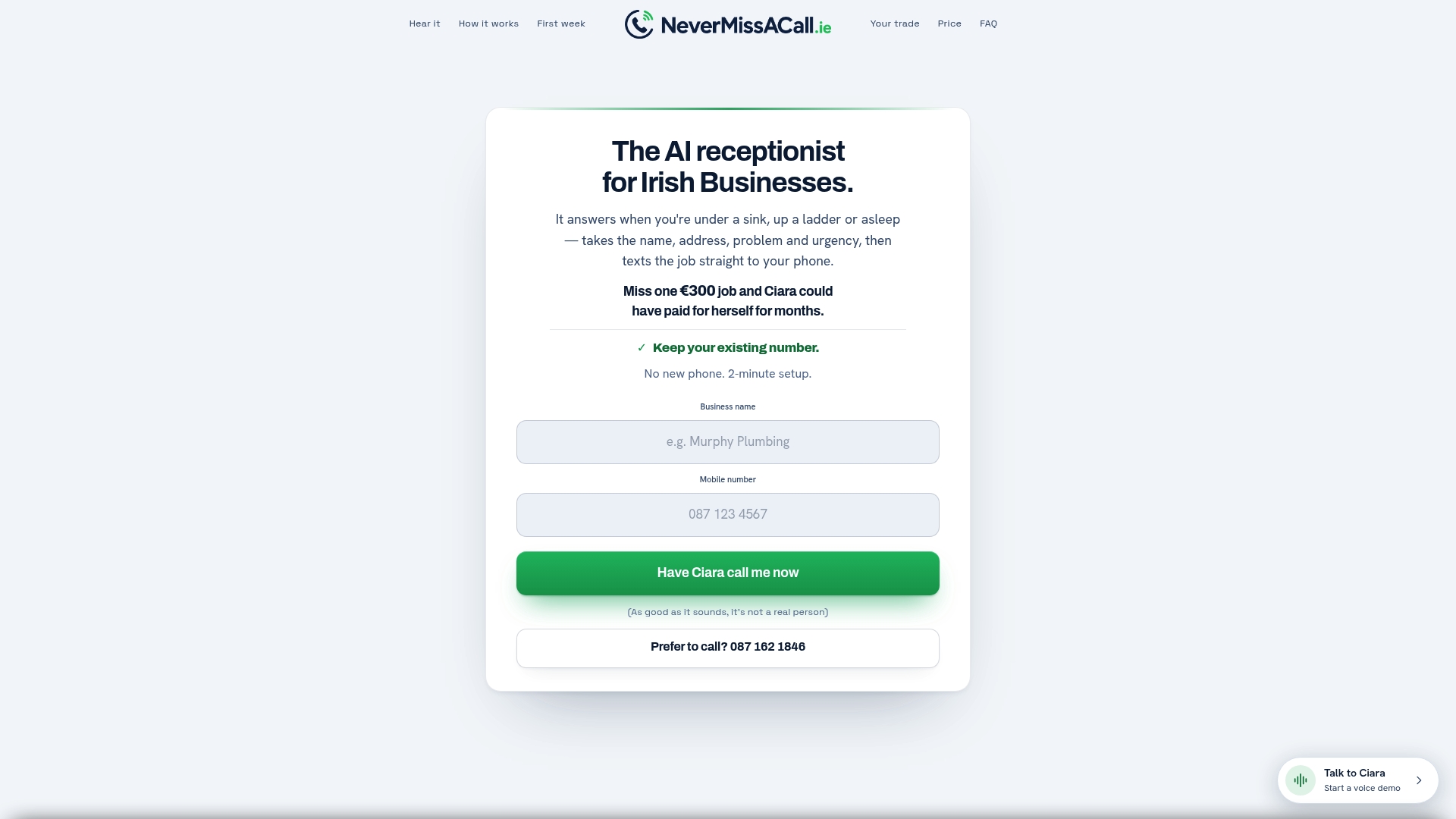
This kind of solution suits trades and small business owners who want to avoid losing jobs to voicemail but may not have the budget or staffing to run a full-time desk. Pricing typically involves a monthly subscription agreed before activation, without per-call fees. Visit Nevermissacall to see how Ciara works for your trade and request a demo.
Sources
For deeper technical detail, see Verint's overflow call handling explainer, Zendesk's routing configuration guide, and CloudTalk's overflow management overview.
- What is Overflow Call Handling? 4 Reasons Your Call Center Needs it Now
- Managing overflow calls and after‑hours call routing
- Call Center Overflow: Causes, Costs & Fixes (2026) | Revmo AI
FAQ
What are the best practices for handling calls during a surge?
Forecast your peak times in advance, set overflow queues and backup routing before you need them, offer callbacks to cut perceived wait times, and monitor KPIs in real time so you can adjust thresholds quickly rather than after the damage is done.
What are the four types of calls a business typically handles?
Most trades and service businesses see a mix of new enquiries, existing customer support, emergencies, and administrative or billing calls, each suited to a different overflow strategy, from IVR deflection to AI receptionist capture.
How do you handle a difficult customer over the phone?
Stay calm, acknowledge the specific frustration before offering a solution, and escalate to a human decision-maker quickly if the call is emotionally charged. An AI receptionist like Ciara is built to flag these as urgent so a real person calls back fast, rather than leaving a frustrated customer on hold.
How quickly can overflow call handling actually activate?
Configured correctly, routing rules trigger in real time the moment a queue threshold is met, meaning a caller can be redirected to backup coverage within seconds rather than minutes.