

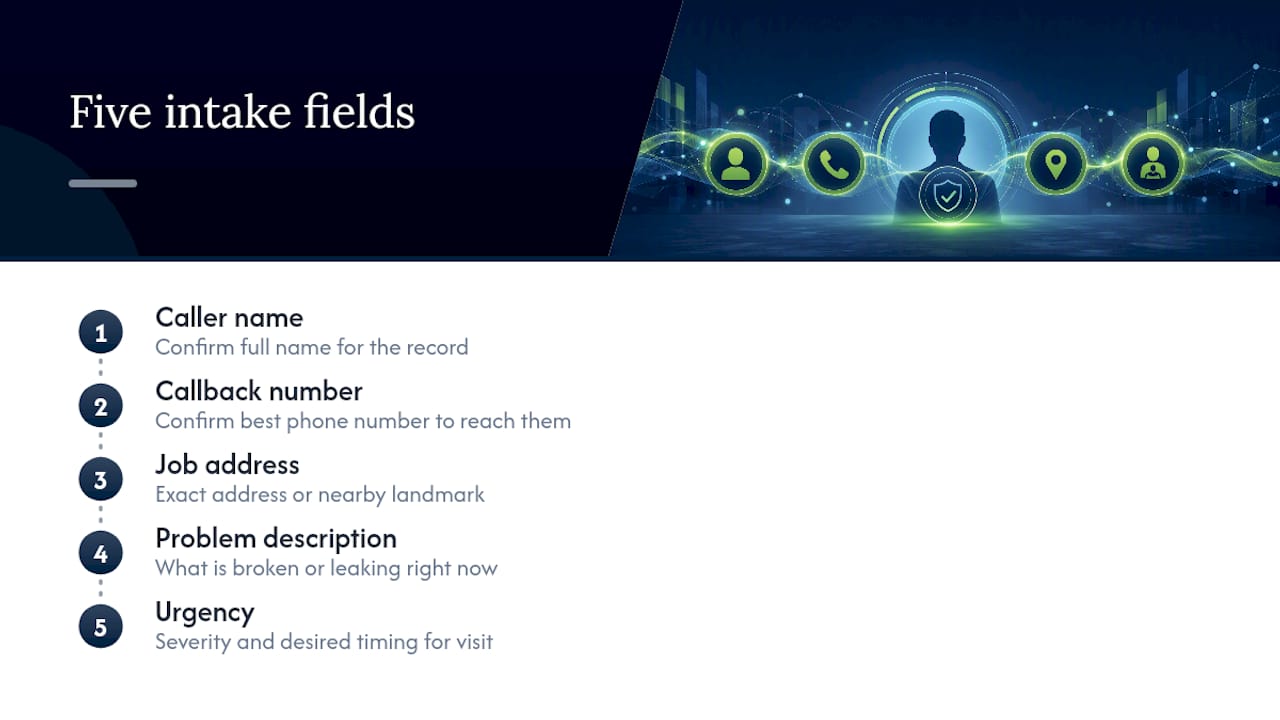
Verifying a caller's identity for a trade business means one thing: capturing the caller's name, best callback number, service address or postcode, a short description of the problem, and an urgency level, then sending a confirmation text before you hang up. That's it. If your AI receptionist or answering process does those five things on every call, you've verified the lead. An AI receptionist can build its entire call flow around exactly this sequence.
TL;DR:
- Verifying a caller for a trade business requires capturing five key fields: name, callback number, address or postcode, problem description, and urgency, with a confirmation text sent immediately.
- Emergency situations such as gas leaks, active water ingress, sparks, or injuries automatically escalate to a human instead of automated booking to ensure safety.
- Cross-checking caller details against existing records in the CRM boosts confidence in leads without adding friction, especially if a prior record exists for the number or address.
- Consistent use of a structured checklist on every call reduces human error and ensures critical details are captured, regardless of call volume or fatigue.
- Asking one question at a time, using landmarks, and explaining the need for callback details helps hesitant callers provide usable information, preventing incomplete or misleading leads.
Table of Contents
- What does "verify caller identity" mean for a trades business?
- How should the script actually sound on a call?
- How do you spot and escalate a genuine emergency?
- Avoiding false positives: common pitfalls in caller verification
- Turning captured details into a job you can act on
- What if the caller is vague, hesitant, or won't give full details?
- Can you cross-check a caller's details against past records?
- How do you handle a suspicious or potentially fraudulent call?
- What are the legal and privacy rules around capturing caller details?
- Why a consistent checklist beats instinct on every call
- Let Ciara run this checklist on every call you miss
- Sources
- FAQ
What does "verify caller identity" mean for a trades business?
Most articles on caller verification talk about spoofed numbers, voice biometrics, and network authentication protocols. None of that matters if you're a plumber trying to work out whether the person who rang at 7pm has a burst pipe or a dripping tap.
For a tradesperson, verifying a caller means confirming you've got a genuine job lead with enough detail to act on. It's not about proving someone is who they claim to be in a legal sense. It's about capturing accurate, actionable information so you can call back the right person, at the right number, about the right job, with the right urgency attached.
That distinction matters because it changes what "verification" actually requires. You don't need a database lookup. You need a structured conversation that captures five fields correctly, every time, whether the caller is calm and clear or flustered and vague.
The essential intake checklist
Every call your business answers, whether by a human or an AI receptionist, should walk away with these fields filled in:
- Name and best callback number. Without this, you're calling back blind, or worse, dialling a wrong number because someone misheard a digit.
- Service address or postcode. This confirms you actually cover the area and lets you estimate travel time before you commit to a slot.
- Problem description, in the customer's own words. A vague "the heating's not working" versus "the boiler's making a banging noise and the pressure gauge is at zero" tells you completely different things about materials and time on site.
- Urgency level. Emergency, same day, or routine. This single field decides whether the job jumps the queue or waits for Thursday.
- Access notes. Parking restrictions, dogs on site, gate codes, or a locked side entrance. Turning up to a job you can't actually get into wastes a slot that a real emergency could have filled.
Miss any one of these and you've got a lead that looks captured but isn't usable. The essential intake list recommended across contractor answering setups rarely varies from this shape, because trades work runs on the same constraints everywhere: access, urgency, and accurate contact details.
How should the script actually sound on a call?
Scripted doesn't have to mean stiff. The best AI answering flows open with the business name, ask what's going on, and only then start collecting structured detail, so the caller feels heard before they feel processed.
A workable sequence looks like this:
- Opening line: "Hi, you've reached [Business Name], this is Ciara. What's going on today?" Let the caller explain in their own words first. You capture the problem description naturally, without sounding like a form.
- Contact capture: "Can I grab your name and the best number to reach you on?" Straightforward, and it signals you're taking the job seriously.
- Address and urgency: "And what's the address for the job? Is this something you need looked at today, or can it wait for a scheduled visit?"
- Confirmatory readback: "So that's [name], at [address], and it's the immersion heater that's tripping the fuse. Did I catch that right?" Repeating it back catches misheard names and mangled postcodes before they become a wasted callback.
- Confirmation text: Immediately after the call, a text goes to both the caller and the business owner summarising the captured fields and next steps, without promising a specific arrival time.
Pro Tip: Build the readback into every call, not just the ones that sound unclear. Callers rarely correct you unprompted, even when you've got their name or postcode wrong, so ask anyway.
That final text matters more than it looks. A single confirmation message that sets expectations rather than promising a fixed arrival time cuts down on repeat calls from customers chasing an update.
How do you spot and escalate a genuine emergency?
Not every "urgent" call is actually urgent, and not every calm-sounding caller is safe to schedule for next week. The job of your intake process is to sort the two quickly and correctly.
Ask direct urgency questions rather than relying on tone: "Is water actively coming through a ceiling or wall right now?" "Can you smell gas, or has an alarm gone off?" "Are there any sparks or a burning smell from the socket?" Answers to these questions classify the call far more reliably than how anxious the caller sounds.
Certain answers are non-negotiable red flags requiring an immediate human callback, not an AI-handled booking:
- Suspected gas leaks or carbon monoxide alarms
- Active water ingress into electrics or ceilings
- Visible sparking, burning smells, or exposed wiring
- Any mention of injury connected to the fault
When one of these comes up, the system should escalate straight to a human rather than trying to book or quote. Clear rules against promising arrival times or emergency pricing without a person in the loop exist for good reason. An AI receptionist that oversells its authority on a safety call does more damage than one that simply hands the call up the chain fast.
Avoiding false positives: common pitfalls in caller verification
A lead that looks complete on paper can still be useless if the details underneath are wrong. The most common culprits are entirely mundane: a name misheard over a bad line, a postcode read back incorrectly, a caller who gives a vague "just off the main road" instead of an actual address, and the ever-present scripted spam call pretending to be a customer.
A few checks catch most of these before they cost you a wasted trip:
- Read back the postcode and phone number digit by digit, not just once through.
- Ask one trade-specific question a genuine customer would naturally know the answer to (age of the boiler, fuse box location, when the fault started).
- Confirm the callback number a second time near the end of the call, separate from the initial capture.
On privacy, ask only what the job needs. There's no reason to collect a caller's date of birth or unrelated personal details just because you're on the phone. Consistent structured fields like name, phone, address, job type and urgency cover verification needs without overreaching into data you'll never use.
Turning captured details into a job you can act on
Verification only pays off if what happens next is fast and structured. The moment a call ends, three things should happen almost simultaneously.
First, a confirmation text goes out within seconds, not hours, summarising the name, address, problem, and urgency tag. Second, those same fields populate a job card or CRM entry, including access notes, rather than sitting in a voicemail transcript nobody reads. Storing the summary directly in the job record means the technician who eventually takes the job sees the full context, and any dispute later has a paper trail to check against.
Third, the job gets prioritised:
- Emergency jobs jump to the top and trigger an immediate human callback.
- Same day jobs get slotted into the current day's schedule based on location and access notes.
- Routine jobs go into the standard booking queue.
Urgency isn't the only sorting criterion worth using. Scoring leads on urgency, budget signals, and decision authority helps route the highest-value jobs to your calendar first, while lower-priority enquiries still get logged rather than lost.
What if the caller is vague, hesitant, or won't give full details?
Some callers are cagey, not because they're hiding anything, but because they're stressed, distracted, or unsure what information matters. Someone standing in a flooding kitchen isn't thinking clearly about their own postcode.
Ask one question at a time instead of stacking three into a single sentence. "What's the address?" lands better mid-crisis than "Can I get your name, number, and address please?" When a caller gives a half answer, like a street name with no number, ask a narrowing follow-up: "Is that near the school, or further down towards the roundabout?" Landmarks work when postcodes don't.
If someone refuses to give a callback number, explain plainly why you need it: "I just need a number in case we get cut off, so I can ring you straight back." Most hesitation dissolves once the caller understands the request is practical, not intrusive.
Incomplete information isn't automatically suspicious. It's often just a rushed or distressed caller. The fix is patience and structure, not scepticism: capture what you can, flag the gaps clearly on the job card, and let a human follow up on anything critical that's still missing before the job gets booked. A callback number and a rough area are usually enough to get a technician moving, even if the exact postcode arrives later by text.
Can you cross-check a caller's details against past records?
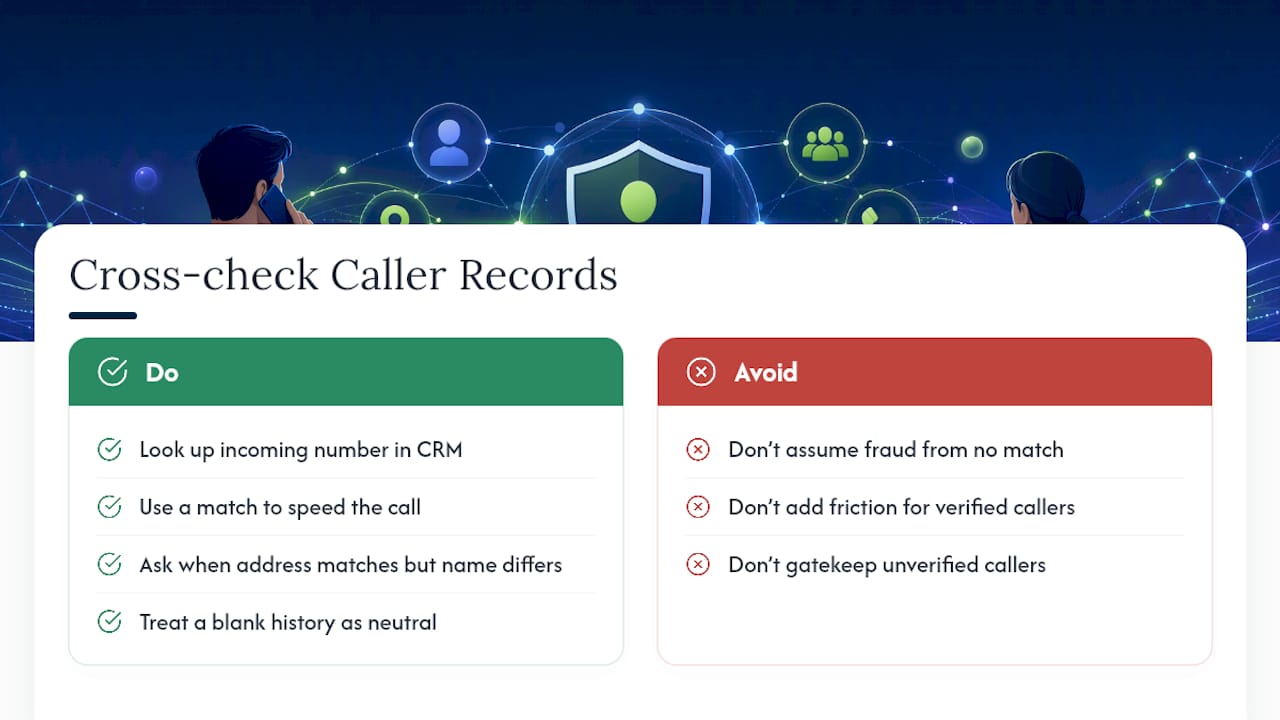
Yes, and it's one of the simplest ways to raise your confidence in a lead without adding friction to the call. If your job history or CRM already holds a record matching the phone number, address, or name the caller gives you, that's an instant confidence boost. A returning customer at a known address needs far less scrutiny than someone with no history at all.
Cross-checking doesn't require anything exotic. A basic CRM lookup against the incoming number, matched to a previous job card, tells you whether this is a repeat customer, a landlord managing multiple properties, or a brand-new enquiry. If the address matches a previous callout but the name doesn't, that's worth a quick clarifying question, since it might be a new tenant or a different household member calling on the same landline.
Where records don't match anything on file, that's not a red flag by itself. Most calls are from new customers, and a blank history is normal. Treat a lack of prior records as neutral, and a matching record as a bonus signal that speeds up the conversation, since you can skip straight to "is this the same issue as last time, or something new?"
The value here is efficiency, not suspicion. Cross-checking exists to save time on calls you can already trust, not to gatekeep the ones you can't immediately verify.
How do you handle a suspicious or potentially fraudulent call?
Most calls to a trades business are exactly what they claim to be. Genuine fraud attempts are rare, but a few patterns are worth training your team, or your AI receptionist, to recognise.
Watch for callers who refuse to give any callback number at all, who provide an address that doesn't exist when you check it, or who push hard for payment details or upfront deposits before any job has been scoped. Repeated scripted-sounding calls with near-identical phrasing, often at odd hours, are usually spam rather than fraud, but they still eat up call-handling time if left unfiltered.
The right response isn't confrontation. If a call feels off, capture whatever details are offered, decline to commit to a booking or quote on the spot, and flag it for a human to review before any callback goes out. Never share other customers' information, and never confirm or deny details about a specific address or job to an unverified caller who's fishing for information about who lives there or what work is being done.
Genuine emergencies should never be delayed by suspicion. If a call describes a safety-critical situation, escalate it as an emergency first and sort out any doubts about the caller's legitimacy afterwards.
What are the legal and privacy rules around capturing caller details?
Collecting a name, number, address, and job description is standard business practice, but it still counts as processing personal data, and that carries obligations. The core principle across data protection law is data minimisation: collect only what the job genuinely requires, and nothing more.
That means no collecting dates of birth, no asking for details unrelated to the job, and no storing call recordings or transcripts indefinitely without a clear retention policy. If your system records calls, callers should be told this is happening, typically through a brief automated notice at the start of the call. Job records containing personal details need reasonable security, whether that's a CRM with access controls or a simple encrypted spreadsheet, and old records that serve no ongoing purpose should eventually be deleted rather than kept forever "just in case."
None of this is complicated in practice. It mostly comes down to asking only job-relevant questions, being upfront about call recording, and not holding onto data longer than you need it for scheduling, invoicing, or warranty purposes.
Why a consistent checklist beats instinct on every call
Every tradesperson thinks they can tell a genuine job lead from a time-waster by instinct. Most can't, not consistently, and definitely not at 6pm after a ten-hour day when the sixth call of the evening sounds exactly like the previous five.
What actually separates a business that converts missed calls into booked jobs from one that doesn't is not better instincts. It's a checklist that doesn't degrade under fatigue, applied the same way whether it's the first call of the morning or the last one before you switch your phone off. Consistent intake reduces lost leads because it removes the variable that causes most drop-off: human inconsistency under pressure.
An AI receptionist can apply the same five-field checklist to every call, gather the details, flag anything that reads as an emergency, and text the summary straight to the business owner. It doesn't get tired, distracted, or short with a hesitant caller on the twentieth call of the day.
— Bartek
Let Ciara run this checklist on every call you miss
An AI receptionist service can run this intake process without hiring a receptionist or letting calls go to voicemail. Every call gets the same five-field treatment: name, callback number, address, problem description, and urgency, followed by an instant confirmation text to the business owner and the caller.
Where this earns its keep is consistency. The AI receptionist doesn't skip the readback because it's the end of a long day, and doesn't forget to ask about access notes because the caller sounded rushed. It can be tailored for trades specifically, so the questions it asks about a blocked drain differ from those asked about a tripped fuse board, and genuine emergencies get flagged and pushed to the business owner immediately rather than sitting in a voicemail queue until morning. Setup runs on an existing phone number, with no app for customers to download and no disruption to how they already reach the business.
If missed calls are currently costing you jobs, Nevermissacall and see the intake checklist working on your own number within days.
Sources
The intake fields, escalation rules, and confirmation workflow in this guide draw on a handful of practical contractor-focused guides rather than academic research, because that's where the real operational detail lives. AI for Contractors shaped the core checklist items and the confirmation text format. ProTradeHQ informed the escalation rules around emergencies and the caution against promising arrival times. Toolfy provided the job-card schema and the case for storing call summaries directly in job records. Dark Harbor contributed the lead-scoring logic behind the prioritisation rules.
- Set up an AI virtual receptionist for your shop — AI for Contractors
- AI call answering for plumbers, HVAC companies, and roofers | ProTradeHQ
FAQ
What five fields should every call capture?
Name, best callback number, service address or postcode, a short problem description, and an urgency level. These form the minimum viable job lead for any trades business.
How quickly should a confirmation text go out after a call?
Within seconds of the call ending, not hours later. A prompt text sets expectations and cuts down on repeat calls from customers chasing an update.
What counts as an emergency that needs immediate human escalation?
Suspected gas leaks, active water ingress into electrics or ceilings, visible sparking or burning smells, and any injury connected to the fault. These should bypass automated booking and go straight to a human.
Can an AI receptionist like Ciara actually verify a caller's identity?
Ciara captures and confirms the five essential fields on every call, reads back key details to catch errors, and flags anything that looks like an emergency for immediate human follow-up.
What should I do if a caller won't give a full address?
Ask one question at a time and use landmarks or nearby streets as a fallback when a postcode isn't available. Capture what you can, note the gap on the job card, and follow up by text for the rest.