
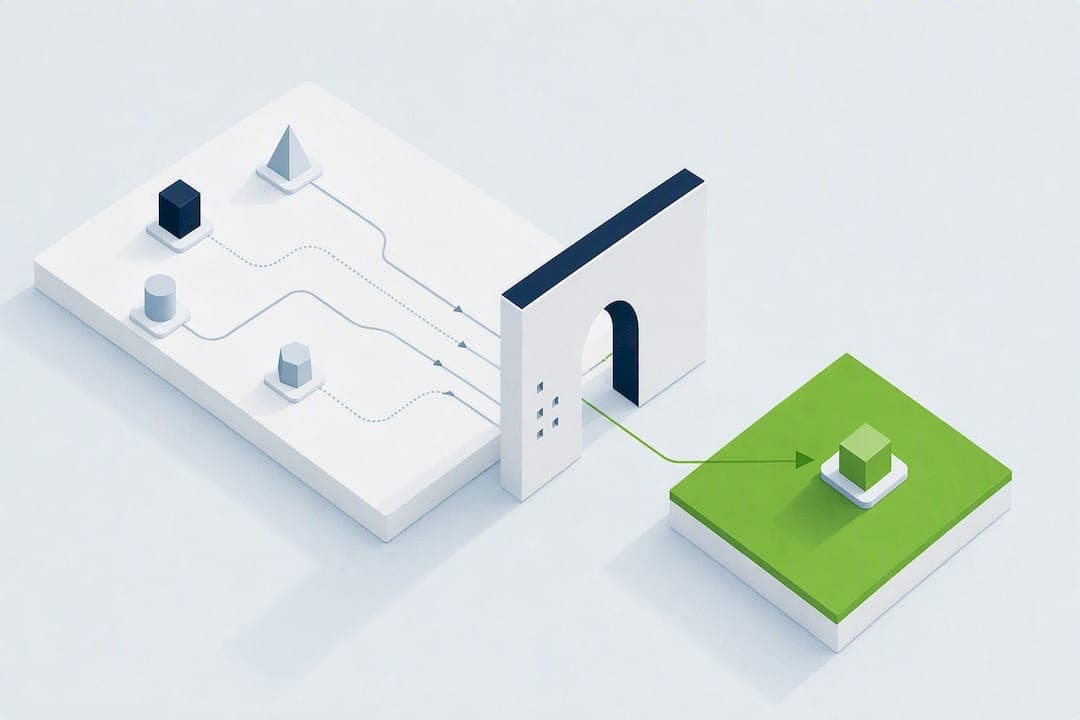
An AI receptionist is software that answers your business phone line, holds a real conversation with the caller, and completes an action, such as booking an appointment or texting you the job details, without a human picking up. It works around the clock, catches calls you'd otherwise miss, and turns them into captured leads rather than lost jobs. It suits appointment-led businesses and trades most: plumbers, electricians, clinics, salons, anyone who loses revenue every time a call goes unanswered.
TL;DR:
- AI receptionists can handle urgent calls outside regular hours, significantly increasing the likelihood of converting inquiries into booked jobs.
- They rely on real-time calendar and CRM integration, with robust fallback systems to prevent missed appointments or silent call drops during failures.
- For trades and small businesses, active conversation with callers boosts conversion rates from around 15-20% to 60-80%, depending on call handling.
- Setting up an AI receptionist involves a trial phase with real calls, clear success metrics, and direct questions about emergency escalation and system reliability.
- Availability and effective implementation in Ireland depend on local support, trade-specific customization, and testing with regional accents and call patterns.
Table of Contents
- What does an AI receptionist do?
- How do AI receptionists work?
- What are the benefits of an AI receptionist?
- What features and integrations should you check?
- How do you get an AI receptionist set up?
- Implementation tips and common pitfalls
- Ciara: a working example of an AI receptionist in Ireland
- Is an AI receptionist available in Ireland, and what should you check?
- When is an AI receptionist actually worth it?
- Sources
- FAQ
What does an AI receptionist do?
Picture a normal working day for a plumber. Two callers ring while you're under a sink. One gets voicemail and hangs up. The other, with an AI receptionist on the line, gets a natural conversation, an appointment booked, and you get a text before you've even wiped your hands.
That's the practical difference. The AI receptionist doesn't just record a message, it acts on the call.
A typical inbound call under an AI receptionist follows a fairly consistent path: the system answers immediately, greets the caller, asks what they need, and then either resolves it directly or gathers the right details to hand off. What it captures usually includes the caller's name, contact number, address, a description of the problem, and how urgent it is. That structured information gets pushed to the business owner, usually by text or a dashboard entry, within seconds of the call ending.
Beyond simple message taking, the system typically handles:
- Booking new appointments straight into a connected calendar
- Rescheduling or cancelling existing bookings without a callback needed
- Routing calls to the right person or department when one exists
- Flagging urgent or emergency situations for immediate attention
- Answering routine questions (opening hours, pricing ranges, service areas) without tying up a human
After-hours handling is where many small businesses see the clearest win. A call at 9pm on a Sunday, from someone with a burst pipe, still gets answered, assessed for urgency, and passed on, rather than sitting in a voicemail inbox until Monday morning. Clinics use the same mechanics for appointment requests outside reception hours; salons use it to fill last-minute cancellation slots. The underlying job is identical across trades: capture the enquiry, judge how urgent it is, and get it to a human fast enough that nothing falls through the cracks.
How do AI receptionists work?
Strip away the marketing language and an AI receptionist is a pipeline with four distinct stages, each doing one job well. Understanding this matters because it tells you which parts of a vendor's pitch are substance and which are gloss.
- Telephony connection. The call reaches the AI system through your existing phone number, using call forwarding or a SIP trunk, so the caller never knows they've reached software rather than a person.
- Speech recognition (ASR). The spoken conversation gets converted to text in real time, which is the layer most affected by background noise, accents, and phone-line quality.
- Intent classification and reasoning. An AI reasoning layer works out what the caller actually wants, whether that's booking a job, asking a question, or reporting an emergency, and decides what to do next.
- Function calling and action execution. The system then calls out to your calendar, CRM, or job management tool to check availability, log the enquiry, or trigger a notification, and the whole exchange is captured as a transcript with structured fields that feed your existing workflow.
That fourth stage, function or tool calling, is where the real engineering work sits. The AI doesn't just guess what should happen. It suggests an action, the application validates that action against your actual calendar or CRM data, and only then executes it. That validation step is what stops a system from double booking a slot or inventing an appointment that doesn't exist.
Pro Tip: When you're comparing providers, ask specifically how they handle a failed integration, such as a calendar API timing out mid call. A system with no fallback plan will either hang the caller or silently drop the booking, and you won't find out until a customer complains.
The handover rules between the AI and a human matter just as much as the AI's conversational skill. A well-built system knows exactly when to escalate, a genuine emergency, an angry caller, a question outside its scope, and does so instantly rather than looping the caller through repeated clarifying questions. Integration reliability, not conversational polish, is usually the difference between a system that works and one that quietly loses jobs.
What are the benefits of an AI receptionist?
The headline benefit is straightforward: your phone gets answered every time, not just when someone happens to be free. For a trade business, that alone changes how many enquiries convert into paid jobs.
The gap in outcomes between an answered call and a missed one is significant. Callers who reach voicemail convert into booked jobs at roughly 15 to 20%, while callers who get a live, active conversation, human or AI, convert at somewhere between 60 and 80%. That's not a marginal improvement; it's the difference between losing most of your enquiries and keeping most of them.
Voicemail conversion sits around 15 to 20%. An active AI receptionist conversation can push that to 60 to 80%, according to industry analysis. The gap is largely down to one thing: someone (or something) actually answered.
Beyond the headline conversion number, the practical gains stack up:
- Round-the-clock availability without hiring night or weekend staff
- Fewer dropped or abandoned calls during busy periods
- Time saved for owners and staff who no longer chase voicemail messages
- Consistent call handling, every caller gets the same quality of greeting and information capture
- Faster response to urgent jobs, which matters most in emergency trades like plumbing and electrical work
How much this scales depends on your call volume and business type. A one-person tradesperson fielding a handful of calls a day sees a different kind of benefit (mainly stress reduction and fewer missed emergencies) than a multi-line clinic handling dozens of booking requests. Both benefit, but the maths looks different. Customer expectations have shifted too. Service professionals increasingly report that customers expect faster, more responsive service than they did even a few years ago, and an always-answered phone line is one of the simplest ways to meet that expectation without adding headcount.
What features and integrations should you check?
Not every AI receptionist is built the same way, and the differences show up in the features that sit underneath the sales pitch. Before you sign anything, check the following:
- Calendar and booking integration. The system needs real-time access to your actual calendar, not a rough approximation, so it can check genuine availability and avoid double bookings.
- CRM or job-management connectivity. New leads and job details should log automatically into whatever system you already run your business from, rather than sitting in a separate inbox you have to check manually.
- SMS and text alerts. Job details should reach you by text within moments of the call ending, so you can call back or start planning your day without opening an app.
- Emergency flagging. A genuine urgent issue, a burst pipe, no heat in winter, should be identified and surfaced differently from a routine enquiry.
- Trade-specific customisation. A plumber's emergencies aren't a hairdresser's emergencies, and a system that treats every caller identically will miss context that matters.
- Call recording and transcripts. These give you a record to check quality and refine how the system handles tricky calls over time.
- Data handling and retention policies. Ask plainly how long recordings and transcripts are kept, and who can access them.
The pattern worth noticing here is that reliability lives in the boring parts, calendar sync, CRM logging, notification speed, not in how convincingly the AI chats.
How do you get an AI receptionist set up?
Getting started is less complicated than most owners expect, but skipping steps here is where rollouts go wrong.
- Take stock first. List your call types (bookings, emergencies, general enquiries), your existing calendar or CRM, and your busiest call periods before you talk to any vendor.
- Run real test calls. Ask the provider to test with actual background noise, a job site, a busy shop floor, and different accents, not just a quiet office line.
- Set a pilot window. Two to four weeks is typical, long enough to see genuine call volume without dragging the decision out.
- Define what success looks like. Fewer missed calls, faster callback times, and a measurable rise in booked jobs are the three numbers worth tracking.
- Understand the pricing shape. Most providers charge a setup fee plus a recurring monthly cost tied to your plan, rather than per-call or per-minute fees, so ask exactly what's included before agreeing.
- Ask vendors direct questions. How does the system escalate emergencies? What happens if the calendar integration fails mid-call? Can it use your existing phone number?
Costs vary by provider and by how much customisation your trade requires, so treat any online price list with a healthy dose of scepticism until you've had an actual conversation.
Implementation tips and common pitfalls
Start narrow. Pilot one workflow, lead capture or appointment booking, rather than trying to hand over your entire phone operation on day one. Successful rollouts tend to focus on specific tasks like emergency detection rather than attempting to replace a human receptionist wholesale.
Test the speech recognition with real callers in real conditions, not a quiet test line, because a system that works perfectly in a silent office can stumble badly on a windy job site. Set clear handover rules before launch, and make sure your staff know exactly what changes in their day-to-day workflow.
Pro Tip: Read the call transcripts weekly for the first month. They reveal exactly where the system misunderstands callers, information you can use to sharpen how it handles those situations next time.
Finally, check the data retention and privacy policy before you sign, not after.
Ciara: a working example of an AI receptionist in Ireland
An AI receptionist service can answer missed calls, gather the caller's name, address, description of the problem, and urgency level, then text that information straight to the business owner.
A distinguishing feature in some AI receptionists is the trade-specific layer. Such a system can recognise what counts as an emergency within a given trade, like an electrical fault versus a routine enquiry, and flag genuine emergencies for immediate attention rather than treating every caller identically. This tailoring separates a generic call bot from one built for tradespeople specifically.
On setup, such services often work with your existing phone number, need no app installed, and are tested on real calls before going live. For a buyer running the pilot process described earlier, that translates into:
- No number porting or new hardware to configure
- A testing phase using genuine calls rather than scripted demos
- Text notifications that fit directly into the "success looks like faster callback times" measure
- Emergency flagging that maps straight onto the trade-specific customisation item on any evaluation checklist
You can see the current setup details and request a demo on the Nevermissacall site.
Is an AI receptionist available in Ireland, and what should you check?
Availability for Irish businesses tends to hinge on a few practical points rather than broad geography. First, check whether the provider genuinely supports Irish phone numbers and can integrate with your existing line without forcing you onto a new number, since some AI phone systems are built primarily for other markets and treat Irish support as an afterthought.
Second, ask whether the provider understands trade-specific and locally relevant call patterns. An emergency call to a plumber in Cork carries different urgency signals than a routine hairdressing booking in Galway, and a system built with Irish trades in mind will typically handle that distinction more naturally than a generic international tool retrofitted for the Irish market.
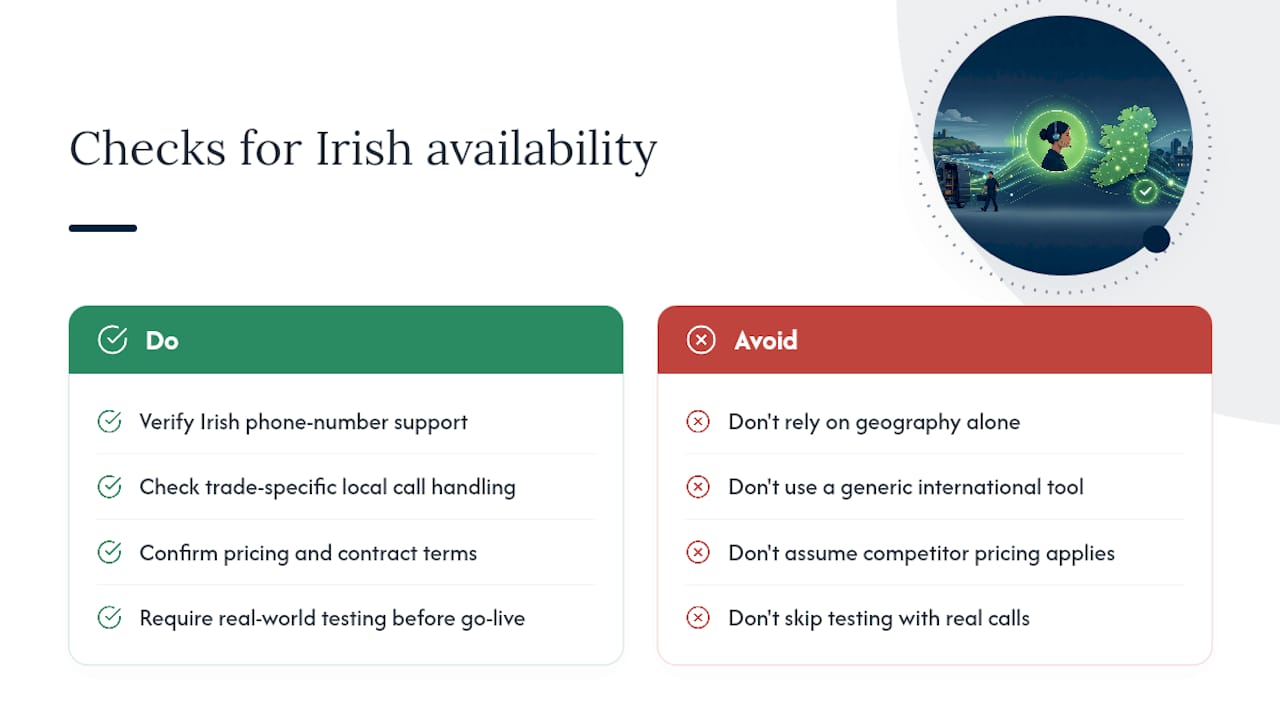
Third, confirm pricing and contract terms directly, since setup fees and monthly costs are usually agreed individually rather than published as a fixed rate card. That's standard practice across this category and not a red flag, but it does mean you should ask for a specific quote before assuming a figure from a competitor's website applies to you.
Finally, ask about testing before go-live. A provider willing to test with real calls in real conditions, background noise, regional accents, typical trade vocabulary, before switching your line over is signalling confidence in their own system. One built specifically for Irish businesses, like Ciara, should be able to demonstrate that fit directly rather than asking you to take it on trust.
When is an AI receptionist actually worth it?
The clearest case for an AI receptionist is a business where a ringing phone equals a potential job, and where nobody's consistently free to answer it. That's most trades, and it's most single-location clinics and salons too.
A plumber fielding emergency calls at odd hours gains the most obvious win: no more choosing between finishing a job and answering the phone. A busy clinic gains something slightly different, fewer abandoned booking calls during peak hours, and a calmer front desk. Both are legitimate reasons to trial one.
My honest recommendation is to stop weighing this in the abstract and run a narrow pilot instead. Pick one workflow, measure your missed call rate before and after, and let the numbers make the decision for you.
— Bartek
Sources
For readers who want the technical detail behind this article, freeCodeCamp's architecture breakdown explains the telephony to action pipeline in more depth. Dev.to's technical explainer covers use cases and conversion data. Salesforce's overview is useful for understanding how AI receptionists differ from chatbots and IVR systems. For conversational design specifics, AmmarAI's work on chat bot architecture is worth a look.
- Dev
- How AI receptionists work: the architecture behind AI phone agents — freeCodeCamp
- What is an AI receptionist? Benefits & how it works | Salesforce
FAQ
What does an AI receptionist do?
It answers inbound calls, holds a natural conversation with the caller, and completes actions such as booking appointments, capturing lead details, and flagging emergencies, then delivers that information to the business owner, typically by text.
Are AI receptionists worth it?
For appointment-led businesses and trades, usually yes: voicemail converts callers into jobs at around 15 to 20%, while an active answered call, human or AI, can convert at 60 to 80%.
Is there an AI receptionist service available in Ireland?
Yes. There are AI receptionist services built specifically for Irish trades and small businesses, with trade-specific emergency recognition and setup that works with your existing phone number.
How do I get an AI receptionist?
Start by listing your call types and existing systems, then run a trial with real test calls before committing, checking pricing, setup fees, and how the provider handles emergency escalation and integration failures.